






Clinical development for a
future beyond daily drops

Positive results for the BIM-IOL System

The SpyGlass BIM-IOL System is being evaluated through preclinical and clinical trials designed to assess long-term drug delivery, safety, efficacy and durability. Positive results from multiple clinical trials demonstrate the system’s potential to deliver sustained bimatoprost therapy and maintain visual outcomes comparable to conventional cataract surgery.1,2

In vitro long-term

In vitro long-term release trial

Objective: Evaluate bimatoprost release from the BIM-IOL System in vitro.1

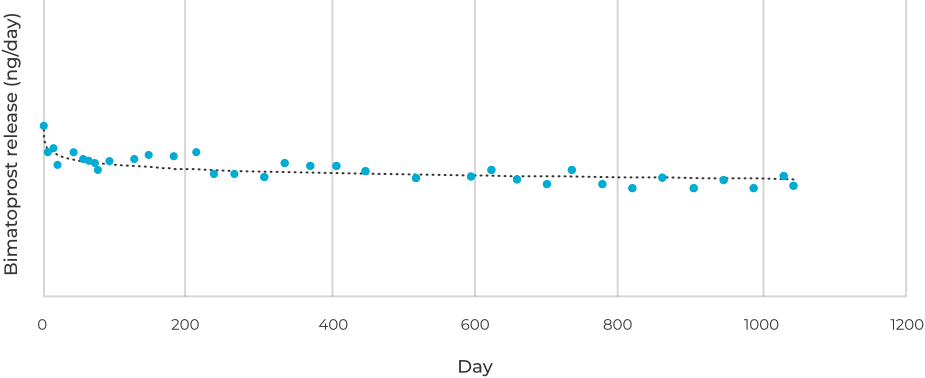
Results: Data demonstrated consistent daily release of bimatoprost over 3 years, confirming the system's ability to provide sustained, predictable dosing over multi-year periods.1

Consistent Daily Release of Bimatoprost Maintained Over 3 Years In Vitro1
Consistent Daily Release of Bimatoprost
First-in-Human

First-in-Human (FIH) clinical trial

Objective: Assess the safety and efficacy of the BIM-IOL System containing 75 µg, 150 µg, and 300 µg of bimatoprost.1

Enrollment: Completed June 2022.1

  • Single-center, ex-US prospective trial designed to assess safety and efficacy of the BIM-IOL System in patients with OAG or OHT undergoing cataract surgery
    • 23 patients previously on 1 to 3 topical IOP-lowering medications enrolled following a baseline 
 medication washout period
    • Participants assigned 1:1:1 to receive the BIM-IOL System containing 75 µg, 150 µg, or 300 µg of 
 bimatoprost
    • BIM-IOL System implanted at the time of cataract surgery
    • Multiple time points of follow-up, including at 1, 3, 6, 9, 12, 18 and 36 months. Patients will 
 continue to be followed through 7 years
  • Primary efficacy endpoints (assessed at each follow-up time-point):
    • Topical glaucoma medication use
    • IOP reduction from baseline
  • Primary safety endpoints:
    • Best corrected distance visual acuity (BCDVA)
    • Adverse event (AE) assessment and slit-lamp examinations
    • Endothelial cell density measurement at 12 months

Key efficacy results at 36 months:

⁨37%

mean IOP reduction across all dose groups2

⁨95%

of evaluable patients off all topical IOP-lowering medications2

⁨100%

of evaluable 
patients achieved 
BCDVA ≥20/302

No significant differences in IOP reduction among dose groups2
Mean IOP Reduction Sustained Through 36 Months Across All Doses3

*Two subjects were discontinued prior to the 36-month visit: 1 subject withdrew consent after moving outside the country and 1 subject was discontinued after receiving a pancreatic cancer diagnosis and was undergoing palliative care.

Patients with BCDVA of 20/30 or better across all doses

At screening1
35%
N=23
At 36 months2
100%
N=21

Safety results:

  • No product-related adverse events (AEs) were reported2
Phase 12 Clinical Trial

Phase 1/2 Clinical Trial

Objective: Compare safety and IOP-lowering efficacy of two BIM-IOL doses (39 µg and 78 µg) versus timolol maleate 0.5% in patients with OAG or OHT undergoing cataract surgery.1

Enrollment: Completed November 2024; 12-month interim data expected 2026.1

  • Prospective, multicenter, randomized, double-masked, controlled trial conducted in patients with OAG or OHT undergoing cataract surgery
  • 104 patients enrolled and randomized in a 2:1:1 ratio into 3 treatment groups:
    • BIM-IOL System (78 µg) and daily artificial tears
    • BIM-IOL System (39 µg) and daily artificial tears
    • Timolol: monofocal IOL + topical timolol maleate 0.5% twice daily
  • All patients underwent baseline washout of IOP-lowering medications
  • Follow-up visits conducted at 2 weeks, 6 weeks, and 3 months, with continued observation planned through 36 months
  • Primary endpoint: Time-matched mean IOP reduction from baseline at Week 2, Week 6, and Month 3
    • IOP measurements taken at 2 time points per visit (8 AM and 10 AM)
  • Secondary endpoints:
    • Mean IOP reduction from baseline
    • Mean IOP time to reintroduction and number of IOP-lowering medications
    • Proportion of eyes achieving BCDVA ≥20/40 at Months 3, 6, and 12
  • Safety assessments:
    • AEs related to IOL implantation and PGA use
    • Endothelial cell density
    • Findings from slit-lamp examination
    • Patient-reported quality of vision

Phase 1/2 at a glance: What 3-month data shows

⁨37%

mean IOP reduction across all dose groups2

⁨97%

of evaluable patients off all topical IOP-lowering medications2

⁨100%

of evaluable 
patients achieved 
BCDVA of ≥20/402

Efficacy results in detail (Month 3)

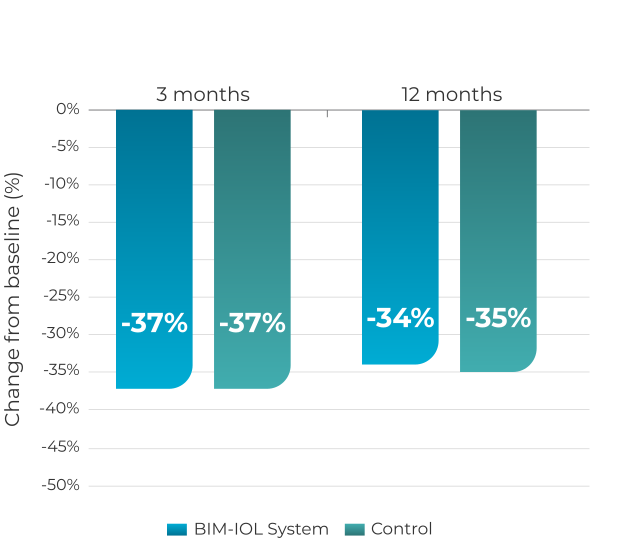
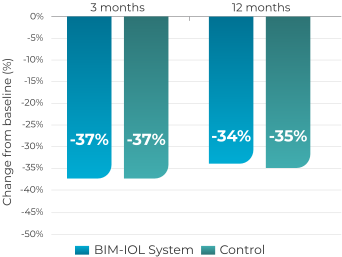
  • 37% and 36% reduction in mean IOP in 78 μg and 39 μg dose groups, respectively, at 8 AM2
    • 37% mean IOP reduction in control group at 8 AM2
  • Mean IOP reduction:
    • 78 µg: -9.29 mmHg (8 AM), -9.19 mmHg (10 AM)1
    • 39 µg: -9.64 mmHg (8 AM), -8.70 mmHg (10 AM)1
    • Timolol control: -9.63 mmHg (8 AM), -10.24 mmHg (10 AM)1
Mean IOP Reduction Sustained Over 3 Months Across All Doses

AT 3 MONTHS

71 OF 73 BIM-IOL
SYSTEM PATIENTS

DID NOT REQUIRE IOP-LOWERING DROPS2

Proportion of Eyes Not Requiring Additional Topical IOP-Lowering Medications3

*All control patients were prescribed topical timolol, per protocol.

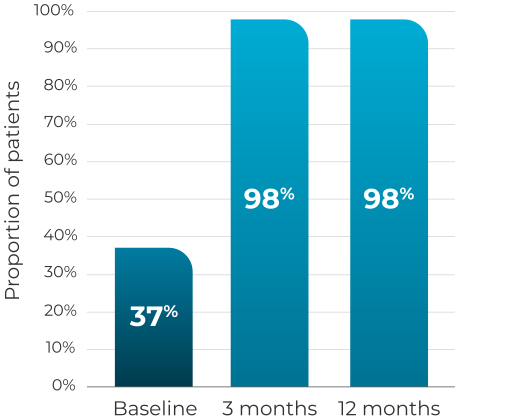
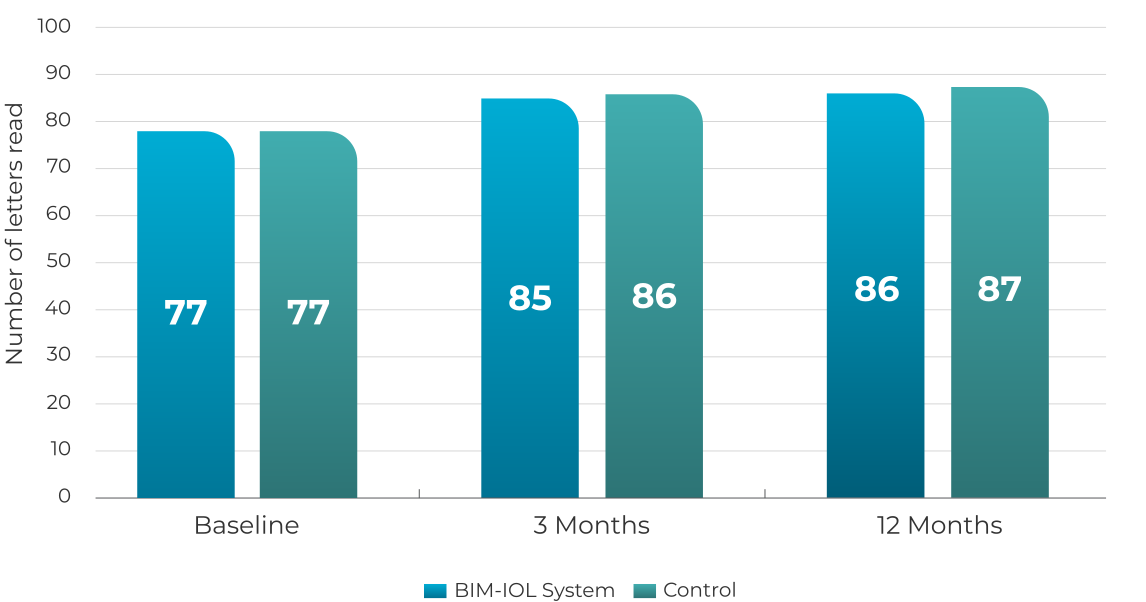
  • Vision improvement: Consistent with current state-of-the-art monofocal IOLs. 100% of patients who received the BIM-IOL System achieved 20/40 or better BCDVA and mean BCDVA of ~20/20 vision (85 to 86 letters)—no difference in control arm2
Mean BCDVA by Number of Letters Read3

Overall safety results were comparable to control

  • Adverse event (AE) rates were similar across the 78 µg (35.3%), 39 µg (39.1%), and control (33.3%) groups3
  • No serious ocular AEs were observed1

Phase 3 Clinical Trials

We have initiated two identical, registrational, Phase 3 clinical trials to evaluate and compare IOP-lowering efficacy, BCDVA outcomes, and safety of the BIM-IOL System (78 µg) versus standard of care in patients with OAG or OHT undergoing cataract surgery. Participants will be followed through 36 months, allowing us to compare long-term safety, efficacy, and durability. Each trial is expected to enroll approximately 400 patients across 45 clinical sites.1
  • Two parallel prospective, multicenter, randomized, masked, controlled Phase 3 trials designed to support regulatory submission
  • Both trials were designed to demonstrate noninferiority of the BIM-IOL System compared to the standard of care (monofocal IOL + timolol)
  • Each trial will enroll approximately 400 patients across 45 clinical sites in the US, New Zealand, and Asia
  • Participants will be randomized 1:1 to receive either:
    • BIM-IOL System (78 µg)
      and artificial tears
    • Surgeon's choice of monofocal IOL with daily topical timolol maleate 0.5% twice daily
  • All patients will undergo a baseline washout of IOP-lowering medications prior to surgery and receive treatment in the study eye

Identical Design for Each of the Two Phase 3 Clinical Trials (SGP-005 and SGP-006)

  • Co-primary endpoints:
    • Time-matched mean IOP change from baseline
      (8 AM and 10 AM measurements)
      at 2 weeks, 6 
 weeks, and
      3 months
    • BCDVA of 20/40 or better
      at 12 months
  • Secondary endpoint:
    • IOP change from baseline
    • Time to postoperative introduction of IOP-lowering medications
    • Number of IOP-lowering medications introduced postoperatively
  • Trial duration:
    • Participants will be followed through 36 months to assess long-term safety, efficacy, and 
 durability of IOP control

Clinical perspectives on a new era of sustained drug delivery

These expert-led videos highlight key findings from the BIM-IOL System clinical program—including sustained IOP-lowering, day-to-day patient impact, and seamless integration into standard cataract surgery—offering a clear view of the system’s potential in practice.

Hear from a leading Phase 1/2 investigator of the BIM-IOL System

Dr. Jeffrey A. Kammer shares key insights from early clinical evaluation.

Explore the future of our sustained drug delivery platform.

Please confirm you wish to leave
SpyGlassPharma.com

Please confirm you wish to open the SpyGlass LinkedIn page in another window.

Skip to content